
Contested Divorce in Delhi: Grounds, Process, Timeline & Your Rights
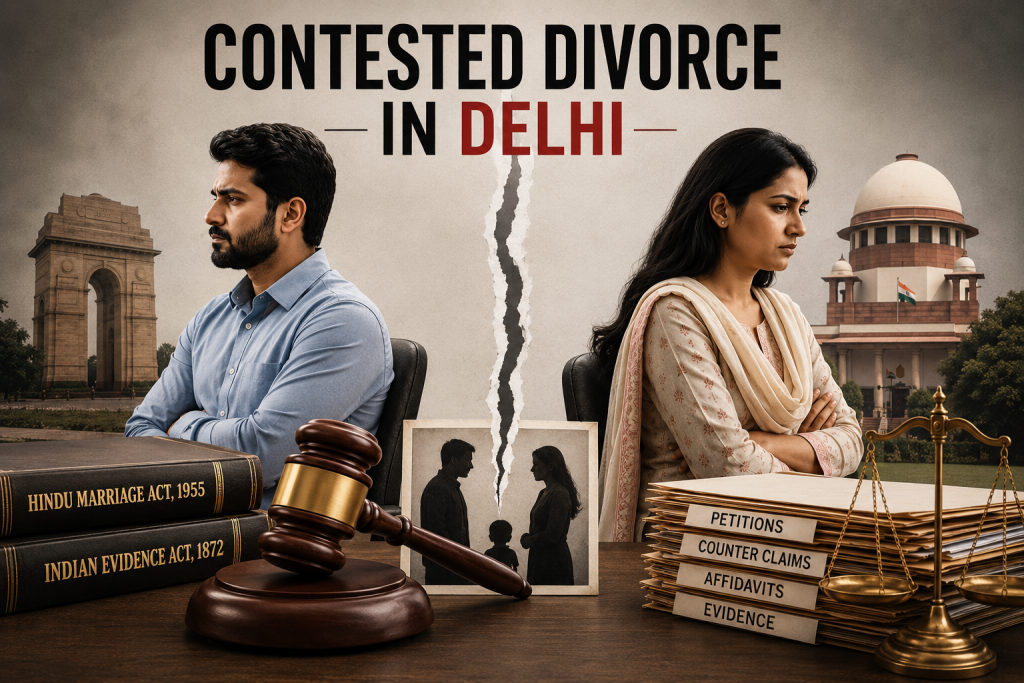
Not every marriage ends by agreement. When one spouse wants a divorce and the other does not — or when the two cannot agree on alimony, custody or property — the only way forward is a contested divorce in Delhi. Here, one spouse files on specific legal grounds, and the court grants the divorce only after hearing evidence from both sides.
A contested divorce is longer and more demanding than a mutual consent divorce, but it exists precisely for situations where consent is impossible — abuse, abandonment, betrayal, or a spouse who simply refuses to let go. This guide explains the legal grounds, the step-by-step court process in Delhi, how long it takes, the interim protections you can claim, and how a family lawyer strengthens your case. (This is general information, not legal advice — please see the note at the end.)
What is a contested divorce?
A contested divorce is one where the spouses do not mutually agree to end the marriage on agreed terms. One spouse (the petitioner) files a petition stating a recognised legal ground, and the other spouse (the respondent) is given the chance to defend. The court examines the evidence and decides whether the ground is proved before granting a decree.
The applicable law depends on how you were married — most commonly Section 13 of the Hindu Marriage Act, 1955 for Hindu marriages, and Section 27 of the Special Marriage Act, 1954 for inter-faith or registered marriages.
Grounds for a contested divorce
Under Section 13(1) of the Hindu Marriage Act, either spouse can seek divorce on grounds including:
- Cruelty — physical or mental cruelty that makes living together unsafe or unbearable. In the landmark case Samar Ghosh v. Jaya Ghosh (2007), the Supreme Court recognised that sustained mental cruelty — not just physical harm — is a valid ground.
- Adultery — voluntary sexual relations by the spouse with another person.
- Desertion — abandonment without reasonable cause for a continuous period of at least two years.
- Conversion — the spouse has ceased to be a Hindu by converting to another religion.
- Unsound mind or mental disorder — of a kind and degree that the petitioner cannot reasonably be expected to live with the spouse.
- Communicable disease — a virulent and incurable form of a communicable disease.
- Renunciation of the world — the spouse has renounced worldly life by entering a religious order.
- Presumption of death — the spouse has not been heard of as alive for seven years or more.
The wife has additional grounds under Section 13(2), including that the husband has another living wife from a marriage before the Act, or has been guilty of rape, sodomy or bestiality, or that she was married before turning 15 and repudiated the marriage before 18.
Each ground must be backed by clear facts, dates and evidence. Courts treat these grounds as independent — proving even one is enough for a decree.
What about “irretrievable breakdown of marriage”?
Irretrievable breakdown is not a ground a family court can grant divorce on by itself. However, the Supreme Court — using its special powers under Article 142 of the Constitution, as clarified in Shilpa Sailesh v. Varun Sreenivasan — can dissolve a marriage that has completely and irreparably broken down. This relief comes only from the Supreme Court, not the trial court.
The contested divorce process in Delhi, step by step
Step 1 — Filing the petition
The petitioner files a divorce petition in the appropriate Family Court, setting out the grounds and the relief sought (divorce, maintenance, custody, etc.).
Step 2 — Notice to the respondent
The court issues a notice or summons to the other spouse, who is given an opportunity to appear and respond.
Step 3 — Written statement
The respondent files a written statement replying to the allegations and may raise their own claims or counter-allegations.
Step 4 — Mediation and reconciliation
Family Courts in Delhi usually refer couples to mediation first, to explore whether a settlement is possible. Many contested matters convert into mutual consent at this stage, saving years of litigation. If mediation fails, the case continues.
Step 5 — Framing of issues and evidence
The court frames the issues to be decided. Both sides then lead evidence — affidavits, documents, and witnesses, who are examined and cross-examined. This is usually the longest phase.
Step 6 — Final arguments and judgment
After evidence, lawyers present final arguments, and the court delivers its judgment, granting or refusing the divorce. Either party may appeal to the High Court.
Interim protections while the case is pending
A contested divorce can take years, so the law allows important interim relief during the case:
- Interim maintenance and litigation expenses under Section 24 of the Hindu Marriage Act, so a financially weaker spouse can sustain themselves and fight the case.
- Maintenance under Section 125 of the CrPC (now Section 144 of the Bharatiya Nagarik Suraksha Sanhita, 2023).
- Interim custody and visitation orders for children, always decided by the child’s welfare.
- Protection orders under the Protection of Women from Domestic Violence Act, 2005, where there is abuse.
Where is a contested divorce filed in Delhi?
Contested petitions are filed in Delhi’s Family Courts, located across court complexes such as Saket, Dwarka, Rohini, Tis Hazari, Karkardooma and Patiala House. The correct court generally depends on where the couple last lived together, where the marriage took place, or where the respondent resides. Your advocate will confirm the right jurisdiction.
How long does a contested divorce take?
There is no fixed timeline. A contested divorce commonly takes two to five years, and longer if there are appeals. The duration depends on the complexity of the dispute, the volume of evidence, the cooperation of both parties, and court schedules. This is why, wherever a fair settlement is realistically possible, converting to mutual consent is almost always faster and less painful.
Contested vs. mutual consent — which applies to you?
If both spouses agree to divorce and can settle the terms, a mutual consent divorce is quicker, cheaper and far less stressful. A contested divorce becomes necessary when one spouse refuses, when there is serious wrongdoing such as cruelty or adultery, or when the parties simply cannot agree on money or children. Even after a contested petition is filed, many couples reach a settlement through mediation and switch to mutual consent — so the two paths are not mutually exclusive.
Why you need a family lawyer for a contested divorce
A contested divorce is won or lost on evidence and procedure. A skilled family lawyer drafts the petition to clearly establish your grounds, gathers and presents the right evidence, protects you through cross-examination, secures interim maintenance or custody, and argues for — or defends against — the relief claimed. Equally important, a good lawyer will tell you honestly when a negotiated settlement serves you better than a long courtroom fight.
Frequently asked questions
Can a contested divorce be converted into mutual consent? Yes. If the spouses reach an agreement at any stage — often during mediation — they can convert the case into a mutual consent divorce, which resolves it much faster.
Can my spouse stop the divorce by refusing to appear? No. If the respondent avoids the court despite proper notice, the case can proceed ex parte (in their absence) and the court may still grant the divorce.
What evidence is needed to prove cruelty? It depends on the facts — medical records, messages, emails, witness testimony, police complaints, or other documents. Mental cruelty can be proved through a consistent pattern of conduct, not only physical harm.
Will I get maintenance during the case? A financially dependent spouse can seek interim maintenance and litigation costs while the case is pending, in addition to any final order.
Is divorce possible if my spouse lives abroad? Yes. Notice can be served on a spouse abroad, and courts have allowed appearances through video-conferencing or a power of attorney in appropriate cases.
Talk to a family lawyer in Delhi
A contested divorce is one of the hardest journeys a person goes through — but you do not have to navigate it alone. If you are facing a contested divorce in Delhi and want clear, confidential advice on your grounds, your rights and your best strategy, Advocate Namrata Singh can guide and represent you at every stage.
📞 +91 63811 87993 | ✉️ advnamratasinghofficial@gmail.com |
Disclaimer: This article is for general information only and does not constitute legal advice. Laws and procedures change and apply differently to each case. Please consult a qualified advocate before taking any step.
